 allerz
How to Choose Wall Art for Your Living Room
A practical guide to choosing art prints that complement your living room, covering sizing, framing, color coordination, and placement for a space that feels curated, not accidental.
The living room is where most people spend the most time, and spend the most energy getting wrong when it comes to wall art. A piece that's too small floats awkwardly above the sofa. Colors that don't relate to the rest of the room create visual noise. A mismatched frame undermines an otherwise beautiful print.
Choosing wall art for your living room doesn't have to be guesswork. This guide walks through the key decisions: sizing, framing, color coordination, placement, and mood, so you end up with a space that feels intentional rather than assembled by chance.
Start with the Wall, Not the Art
Most people do this backwards. They fall in love with a print, buy it, bring it home, and then realize it doesn't work in the space. The better approach: treat the wall as the canvas first.
Before browsing any art, measure your wall and the furniture beneath it. Note the dominant colors in the room: the sofa, the rug, the curtains. Pay attention to the light: does the space get direct sun in the afternoon, or is it a north-facing room with softer, cooler light? These details will inform every decision that follows.
Useful metrics to have ready:
- Width of the sofa or primary furniture piece below the intended hang spot
- Height from the floor to the top of that furniture
- Ceiling height
- Wall color (take a photo in natural light)
Once you know the space, you can shop for art with intention rather than hope.
What Is the 2/3 Rule for Wall Art?
The 2/3 rule is the most reliable sizing guideline in interior design, and it applies directly to how to choose wall art for your living room.
The rule states: the width of your art (or art arrangement) should be approximately two-thirds the width of the furniture below it. If your sofa is 90 inches wide, your wall art or gallery grouping should span roughly 60 inches.
This creates visual balance, with the art feeling anchored to the furniture rather than floating above it. A piece that's narrower than half the sofa width looks undersized no matter how beautiful it is.
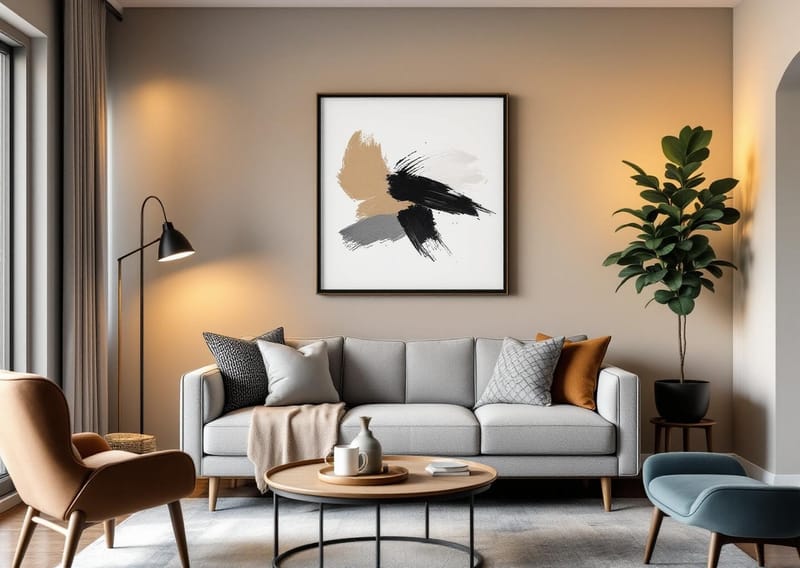
The rule also extends vertically: leave 6–10 inches of space between the top of the sofa and the bottom of the frame. Any closer and the art competes with the furniture; much higher and the connection is lost.
How to Decide What Art to Put on Walls
This is the most personal question in interior design, and the honest answer is: start with what you're drawn to, then filter for fit.
A few frameworks that help:
The room's dominant emotion. What feeling do you want the living room to have? Calm and contemplative? Energetic and bold? Warm and inviting? Art should amplify the emotion, not fight it. A dramatically lit abstract piece in deep noir tones works beautifully in a sophisticated, low-lit space. The same piece in a bright, kid-friendly family room creates tension.
One anchor, the rest support. In most living rooms, one piece should do the heavy lifting, a large-format print or a hero artwork that draws the eye first. Every other piece of wall decor in the room should support that anchor rather than compete with it. This is how galleries think, and it's how well-designed living rooms work.
Relate to something already in the room. A print doesn't need to match your sofa cushions, but it should relate to something already present: a color pulled from the rug, a tone that echoes the wood of the coffee table, an organic form that rhymes with a plant you already love. Total disconnection is the enemy of cohesion.
Color Coordination: How to Match Art Prints to Your Space
Color is often where people feel most uncertain, and most overthink it. A few principles cut through the noise.
Pull, don't match. The goal is to pull a color already present in the room into the artwork, not to find art in the exact same hue as your walls. If your room has warm walnut furniture and a cream rug, look for art prints that carry those warm earth tones, even if the subject matter is something else entirely.
The 60-30-10 rule. In a well-balanced room, 60% of the color is dominant (usually walls and large furniture), 30% is secondary (smaller furniture, rugs), and 10% is accent. Wall art lives in that 10% accent zone. It doesn't need to anchor the whole palette, just complement it.
Neutrals give you flexibility. If your room is largely neutral, whites, grays, beiges, you have enormous freedom with art. You can introduce a strong color statement through a print without risk of clashing. Neutral rooms are the best canvas for bold, saturated artwork.
High contrast for high energy, low contrast for calm. A black-and-white print with strong graphic contrast will energize a space. Softer tonal work, watercolors, impressionist pieces, muted photography, creates a sense of ease. Match the contrast level to the energy you want in the room.
Sizing Your Wall Art for the Living Room
Beyond the 2/3 rule, a few size-related guidelines are worth knowing when choosing wall art for your living room.
Standard print sizes and what they suit:
| Print Size | Best for |
|---|---|
| A4 | Gallery walls, shelves, small accent spots |
| A3 | Medium walls, pairs, smaller spaces |
| A2 | Statement pieces, above sofas in larger rooms |
| A1 | Large walls, open-plan rooms, floor-to-ceiling statements |
The most common mistake is buying a print that's too small. A single A3 print above a 7-foot sofa looks like a postage stamp. When in doubt, go bigger. A larger print always looks more intentional than a small one.
Framing: The Detail That Makes or Breaks Everything
The right frame elevates a good print into something that looks considered and permanent. The wrong frame, or no frame at all, makes even beautiful art look like an afterthought.
Frame finish by room style:
- Natural wood frames suit warm, organic, Scandinavian, or mid-century spaces. They add warmth without weight.
- Black frames are the all-rounder. They work in modern, minimalist, industrial, and traditional spaces. They define the print cleanly and create visual weight.
- White frames suit bright, airy, and Hamptons-style spaces. They let the art breathe and keep the overall look light.
Matching frames across a gallery wall creates cohesion. Mixing frame styles intentionally (same color, different widths) adds character. Mixing randomly often just looks mismatched.
Mat boards add breathing room between the print edge and the frame. A generous mat (2–3 inches on the sides, slightly more on the bottom) makes a print feel more premium and gallery-like.
Placement and Hanging Height
The standard rule is to hang art so its center sits at eye level, approximately 57–60 inches from the floor. This was established by museums as the optimal viewing height for standing adults, and it holds for homes.
The most frequent violation: hanging art too high. This happens because people instinctively hang toward the ceiling, especially in rooms with high ceilings. Resist the urge. Art hung at 57–60 inches to center looks grounded; art hung at 70+ inches looks like it's trying to escape the room.
Exceptions to the eye-level rule:
- Art above a headboard in a bedroom can be lower (you're mostly viewing it from a seated or lying position)
- Art above a fireplace mantle follows the mantle height. Just keep it close (4–8 inches above) to maintain the visual connection
- Gallery walls should be designed as a unit, with the visual center of the whole arrangement at eye level, not each individual piece
Choosing Art for Different Living Room Styles
Minimalist and Scandinavian spaces call for restraint. One or two pieces with strong composition, limited palette, and clean lines. Negative space in the art mirrors negative space in the room. Black-and-white or monochromatic prints work exceptionally well.
Warm, traditional, and eclectic spaces can handle more visual richness: impressionist oil-style prints, rich color, textured work. The key is coherence within the chaos: a defined palette or subject theme that ties the wall together.
Bold, contemporary spaces benefit from art that matches the room's confidence. Large-format prints, strong graphic contrast, maximalist color. Don't play it safe when the room itself isn't playing safe.
Transitional spaces (the catch-all most living rooms fall into) are best served by art that has one strong design choice, a bold color palette, a striking composition, a distinctive style, surrounded by restraint in everything else.
Building a Cohesive Collection Over Time
The most beautifully decorated living rooms are rarely designed in a single afternoon. They evolve: a print added here, a frame changed there, a piece rotated out when it no longer fits.
Think of your living room wall as a slow edit, not a one-time purchase decision. Start with a single strong anchor piece that you genuinely love. Add around it gradually, and don't rush to fill every inch of wall space. Empty wall is not a problem to be solved. It's visual breathing room.
When you're ready to add more, look for prints that share a tonal or stylistic relationship with what you already have. The connection doesn't need to be obvious, but it should exist.
The Short Version
If you only remember a few things from this guide:
- Measure first. Know the wall and the furniture before you shop.
- Use the 2/3 rule. Art width should be roughly 2/3 the width of the furniture below it.
- Go bigger than you think. Most art mistakes are too-small, not too-large.
- Hang at eye level. 57–60 inches to center, no higher.
- Let art relate to the room. Pull colors from what's already there.
- Choose frames intentionally. The frame is part of the design.
- Edit slowly. One great piece beats five mediocre ones every time.
Wall art is the most personal layer of interior design; it's where a space starts to say something specific rather than just functioning well. Take the time to get it right, and the living room becomes a room you actually want to spend time in.